West University Place Tree Ordinance and Renovation Permits
September 24, 2026
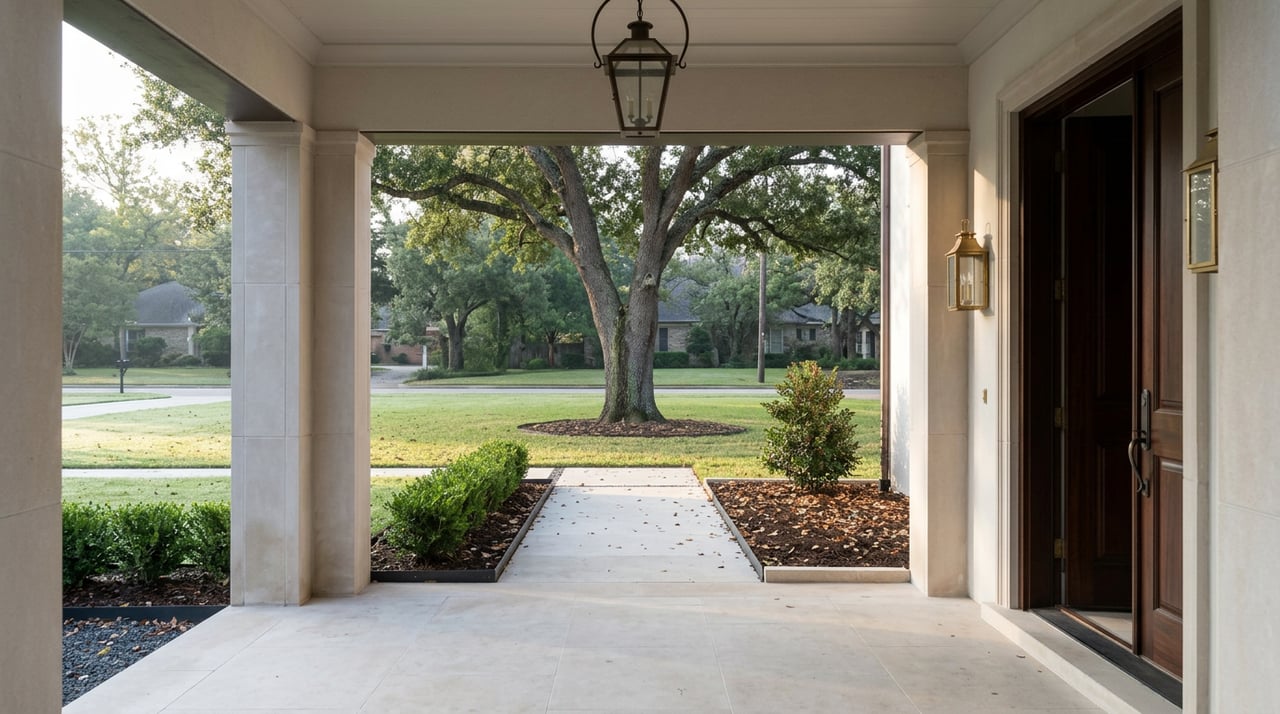
Most homeowners planning a remodel or rebuild in West University Place worry about the wrong tree problem. They picture a fine for cutting down something they shouldn't have. That risk is real, but it isn't the one that actually stops projects. The rule that catches people off guard doesn't punish removal after the fact. It withholds the finish line. The city's Tree Disposition page says a healthy tree that comes down during construction has to be replaced before the house can be finaled, which means your certificate of occupancy, your final inspection, and in some cases your move-in date can sit behind a landscaping obligation nobody flagged at the permit counter.
That structure matters more now than it did a year ago. On March 9, 2026, West University Place City Council voted 3-2 to approve revisions to the city's urban forest ordinance, a change that touches how trees get measured, how "protected" gets defined, and how much enforcement teeth the city is willing to use. If you are buying a teardown lot, planning a major addition, or selling a home where a tree survey is about to become someone else's problem, the mechanics behind that vote are worth understanding before you sign anything.
The revisions came out of recommendations from the city's public works department and an outside urban forestry consultant. Three changes moved together: switching the tree measurement standard from circumference to diameter, sharpening the definition of which trees count as protected, and increasing penalties for violations.
In its report on the vote, Community Impact quoted Public Works Director Michael Leech explaining the reasoning behind the measurement switch:
"Circumference can be challenging to explain to homeowners at times, so diameter is a little more straightforward."
That is not a cosmetic fix. Circumference measurements have long given homeowners and contractors a little interpretive room, since a tape measure wrapped around an irregular trunk produces a number that's easy to argue about after the fact. Diameter, measured straight across, is harder to dispute. Combine a more precise measurement standard with the same vote's decision to strengthen penalties, and the practical effect is a code that's simpler for the city to enforce and harder for a project to talk its way around.
Not everyone on council was comfortable with the direction. Members Clay Brett and Kalie Rainsberger voted against the changes, with Rainsberger raising concerns about how far the ordinance reaches into private property decisions. A second reading was still required to make the changes official as of the vote, with no date set at the time. If you're under contract on a West U property with tree work in the plans, that's worth confirming directly with the city or your contractor rather than assuming which version of the ordinance currently governs your permit.
Here's what makes this more than a measurement footnote: the underlying machinery that makes tree compliance a closing-day problem was already on the books before this vote, and it isn't going anywhere.
Any large tree on a site, generally one with a trunk diameter of 10 inches or more measured 4.5 feet above the ground, has to be identified and protected before a development permit gets issued. That means before the building official signs off on your permit, you need:
The disposition review itself carries a fee: $250 for large construction and swimming pool projects, $150 for shorter-term work like remodels and demolitions. Those numbers are modest against a renovation budget. The obligation attached to them is not. Any healthy tree removed under an approved permit has to be replaced before the house can be finaled, which is the city's term for closing out the permit and clearing the project for occupancy. Skip that step and the tree issue doesn't fade into an old fine on file. It sits between your project and the final sign-off you need to move in or hand over keys.
The city doesn't leave "replace the tree" vague. The ordinance sets a formula, and the formula scales with how much you remove.
The city code requires a standard replacement tree to have a trunk diameter of at least 2 inches, measured 6 inches above the ground. Once a project accumulates 10 or more "replacement inches" of removed trees, the requirement steps up: for every 10 inches, at least one of the replacement trees has to carry a 4-inch diameter trunk rather than the 2-inch minimum. The city's own example lays it out cleanly: a project that owes 24 replacement inches needs at least two trees at 4 inches or larger.
| Replacement inches owed | Minimum larger replacement trees required | Required trunk diameter |
|---|---|---|
| 10 | 1 | 4 inches |
| 24 | 2 | 4 inches |
| 30 | 3 | 4 inches |
There's a diversity rule layered on top: no more than 30 percent of the trees on a site can come from a single genus, so a landscaper can't solve the whole obligation with one species from one nursery run.
None of that is a reason to avoid a project. It is a reason to price and schedule the landscaping phase with the same seriousness as the framing phase. A 4-inch caliper tree is not something you pick up at a big-box garden center on the way to your final walkthrough. Sourcing, delivery, and planting for larger replacement stock typically needs to be lined up weeks ahead, and nursery availability for the right size can be its own scheduling constraint, especially if several West U projects are drawing from the same suppliers in the same season.
If you're evaluating a teardown lot, ask for the tree survey before you write an offer contingent only on the usual inspection items. A lot with several large trees near the buildable envelope can carry a meaningfully larger replacement obligation than a comparable lot next door.
If you're selling a home where construction is underway or recently finished, confirm with your builder that every removed tree has been replaced to the code's specification and that the urban forester has signed off. A buyer's inspector may not think to check tree compliance, but a title issue or a incomplete final inspection tied to it can surface at the worst possible time in a transaction.
If you're mid-project right now, the safest assumption is that enforcement is moving toward less flexibility, not more. A council that just voted to strengthen penalties and simplify measurement is not signaling a lighter touch. Get your disposition conditions approved in writing, keep your replacement tree receipts and planting documentation, and don't treat the landscaping line item as something to finalize after the punch list.
Does this apply to remodels, or only new construction and teardowns? The tree disposition process applies to both. The city sets a lower fee for shorter-term projects like remodels and demolitions, $150 versus $250 for large construction, but the survey, protection, and replacement requirements apply whenever development activity could affect a protected tree.
What if a tree dies from construction damage rather than deliberate removal? The ordinance treats damage that could result in a tree's death, immediately or within two years of the triggering action, the same way it treats removal for replacement purposes. That two-year window is worth knowing if a tree declines well after your project wraps.
How do I find out whether the March 2026 measurement change is currently in effect? A second reading was still pending when the council vote was reported. Before assuming which standard applies to your permit, confirm current status directly with the city's Public Works or Development Services office rather than relying on the vote date alone.
Tree compliance in West University Place is not a reason to delay a project you've already planned carefully. It is a reason to plan the landscaping phase with the same lead time you'd give the framing crew. If you're weighing a teardown lot, mid-renovation, or getting a West U home ready to list, Tahira Syed can walk through what a property's tree survey and permit history actually mean for your timeline. Schedule a personalized market consultation before you're the one waiting on a certificate of occupancy.
This article is general information, not legal, tax or financial advice. Consult a qualified professional about your situation.
Stay up to date on the latest real estate trends.
When it's time to move, you need someone who will advertise your home, show it to prospective buyers, negotiate the purchase contract, arrange to finance, oversee the inspections, handle all necessary paperwork and supervise the closing. Tahira can take care of everything you need, from start to close.