West University Place Home Prices and Land Value
August 27, 2026
August 27, 2026
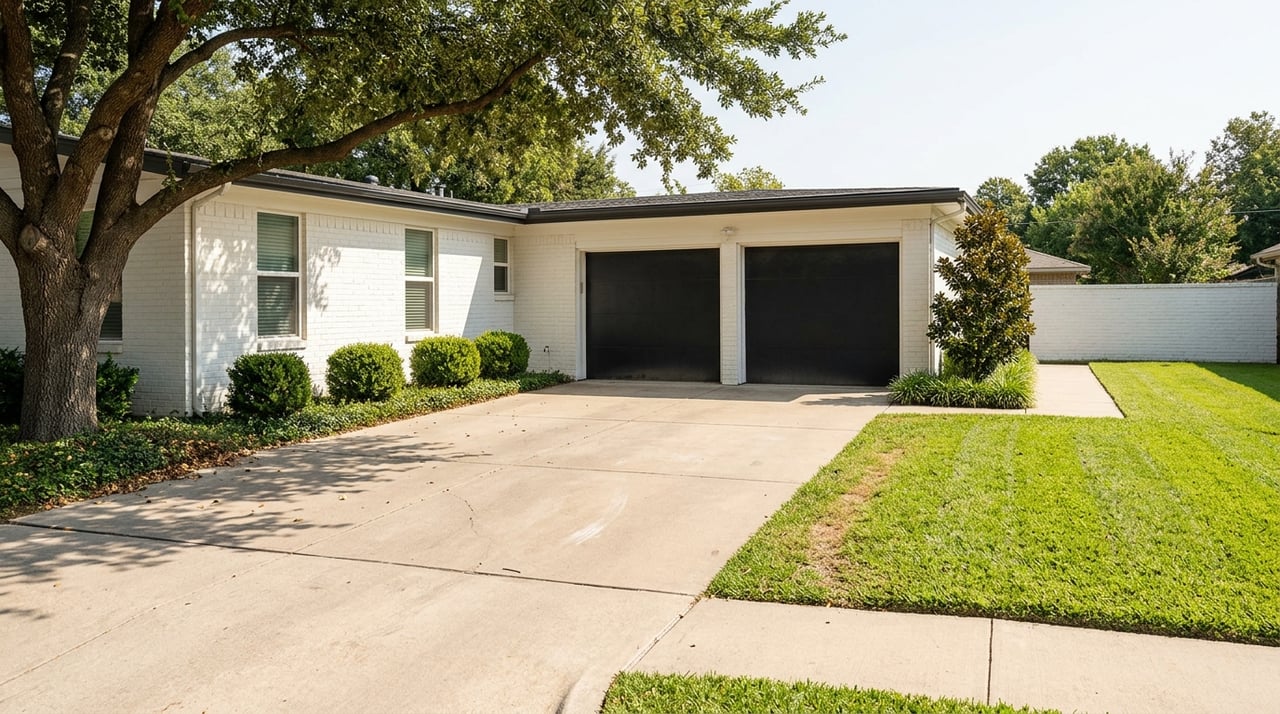
Two houses go on the market three doors apart in West University Place. One was gutted to the studs eighteen months ago: new kitchen, primary suite addition, foundation work, the works. The other still has its 1962 galley kitchen and a single bathroom with the original pink tile. They list within $40,000 of each other.
A buyer touring both, especially one relocating on a tight timeline from out of state, could be forgiven for assuming the pricing is a mistake, or that the renovated house is somehow overpriced. Neither is true. What's actually happening is that both listings are pricing the same thing, and it isn't the house.
Harris Central Appraisal District publishes an explainer on a concept called highest and best use, and it applies directly to blocks like this one. The idea is straightforward: when the most profitable, practical use of a property shifts from "keep the existing house" to "tear it down and build something else," appraisal theory holds that the value tied to the property transfers to the land underneath it. If the typical buyer on that street would demolish whatever is standing there, the buyer isn't really paying for the house. They're paying for the dirt.
This isn't a fringe theory or an agent's rationalization. It's the working assumption baked into how the appraisal district treats neighborhoods in transition, and West University Place is close to the textbook case. The city is 2.1 square miles, fully built out, with a fixed number of lots and no room to add more. When demand for those lots outpaces demand for the specific houses sitting on them, the market stops pricing bathrooms and kitchens and starts pricing setback compliance and lot dimensions instead.
If you've already looked up the median price for West University Place, you've probably noticed the sources don't agree with each other, and the disagreement itself is a clue.
As of August 2026, HAR's own market snapshot puts the average home price in West University Place at $2,310,910, or $612 per square foot. A separate June 2026 reading shows a median sale price of $1,933,948, up 4.5% year over year. Zillow's home value index, updated through May 31, 2026, estimates the typical home's value at $1,828,597, up a more modest 2.3% over the past year.
That's a spread of nearly $500,000 between the highest and lowest of the three, all describing the same 2.1-square-mile city in the same year. The gap isn't measurement error. An average gets pulled upward by a handful of $3 million and $4 million custom builds closing in any given month. A median sits in the middle of whatever mix of homes actually sold. A home value index tries to estimate the typical value across the entire housing stock, including houses that aren't for sale at all, which means it leans more heavily toward the older, unrenovated homes that still make up much of the city's inventory.
Put plainly: the average is closer to what new construction costs. The index is closer to what an average existing structure is worth before anyone touches it. The distance between them is roughly the size of the teardown premium itself.
None of those three headline figures separate land value from structure value on their own, but the underlying construction economics do it for you.
| Line item | Typical 2026 range |
|---|---|
| Existing lot purchase | $700,000 to $1.8 million |
| New custom construction (3,500 to 5,500 sq ft) | $1.4 million to $3.2 million |
| Total project cost | $2.5 million to $5 million+ |
| Typical lot width | 50 feet |
| Typical lot size | 5,500 to 6,500 sq ft |
| City permit timeline, clean submittal | 4 to 8 weeks |
The lot line and the construction line don't overlap much. A buyer paying $1.8 million for a lot on a premium street isn't paying that because of anything standing on it. They're paying for 50 feet of frontage inside a school zone that can't expand, in a city that has its own building department and its own code separate from Houston's, with permit review that typically clears in four to eight weeks for a straightforward project and longer if tree preservation or floodplain review gets triggered.
This has a direct consequence for anyone deciding whether to update a home before selling it. If a street has already tipped toward teardown activity, the buyer pool showing up to tour a listing is disproportionately builders and buyers who plan to build, not buyers evaluating the quality of a recent remodel. Spending $200 to $350 per square foot on a full gut renovation doesn't help much if the eventual buyer is going to demolish the work anyway. Spending $50 to $125 per square foot on cosmetic updates, fresh paint, updated fixtures, refinished floors, helps even less for the same reason.
That doesn't mean every West U seller should skip improvements. Plenty of streets in the city still trade primarily as homes rather than as future building sites, particularly where lots are narrower or set further from the highest-demand school feeder patterns. The distinction matters block by block, sometimes house by house, and it's worth confirming before committing six figures to a renovation that the market may not price back into the sale.
For a buyer, the practical shift is in what to measure. Price per square foot of finished living space tells you almost nothing on a block where the structure's contribution to value is close to zero. Lot width, lot depth, street position, and proximity to the most sought-after HISD feeder patterns tell you far more about why one listing costs what it costs than any comparison of granite countertops.
This matters most for buyers on a compressed timeline, including physicians and researchers relocating for a Texas Medical Center or Rice University appointment who don't have months to spend comparing renovation quality across a dozen showings. Understanding early that the number on the listing is largely a land number changes what questions are worth asking an agent and what a fair offer actually looks like.
It also matters for anyone planning to build after closing. Because West University Place runs its own permitting process independent of the City of Houston, a buyer who assumes Houston's timelines and rules will apply is working from the wrong playbook. The city's permitting office handles applications in person, reviews against its own code amendments, and layers in tree preservation and drainage requirements that can add real time to a project a buyer expected to move quickly.
Houston's inner loop has been running this experiment for a long time. Texas Monthly documented the same land-over-structure dynamic reshaping West University Place decades ago, back when it was still a novelty rather than the default. What's changed since then isn't the mechanism. It's the price at which the mechanism operates, and how far it has spread to the surrounding blocks and neighboring cities.
For a buyer or seller trying to make sense of a listing today, that history is useful mostly as reassurance that the pattern is structural rather than a temporary spike. The lot has been the product for a long time. The house on top of it is increasingly just packaging.
Does this mean I shouldn't renovate before selling in West University Place? It depends on the specific street and lot. On blocks where teardown activity is already common, a full renovation often costs more than it returns at sale. On blocks where original homes still trade as homes, updates can still add real value. The right answer requires looking at recent comparable sales on that exact street, not a citywide average.
How can I tell if my street has tipped into teardown territory? The clearest signal is what's actually happening on the block: how many recent sales resulted in demolition versus renovation, and what the resulting new builds sold for compared to nearby original homes. A specific block-by-block review is worth doing before deciding whether to invest in improvements or sell as-is.
Does the land-value effect apply to townhomes or condos in West University Place? No. This dynamic is specific to single-family lots where the buyer has the option to demolish and rebuild. Townhomes and condominiums involve shared land and structures under a different ownership and appraisal framework, so the same logic doesn't transfer directly.
Understanding which side of that line your street sits on, and what it means for your specific lot, is exactly the kind of judgment call that benefits from someone who tracks these blocks year over year rather than reading them off a single listing. Tahira Syed has spent nearly two decades working these streets in Bellaire and the Inner Loop and can walk through what your specific address is actually worth, structure and land separately, before you list or make an offer. Schedule a personalized market consultation to get that read on your situation.
Stay up to date on the latest real estate trends.
When it's time to move, you need someone who will advertise your home, show it to prospective buyers, negotiate the purchase contract, arrange to finance, oversee the inspections, handle all necessary paperwork and supervise the closing. Tahira can take care of everything you need, from start to close.